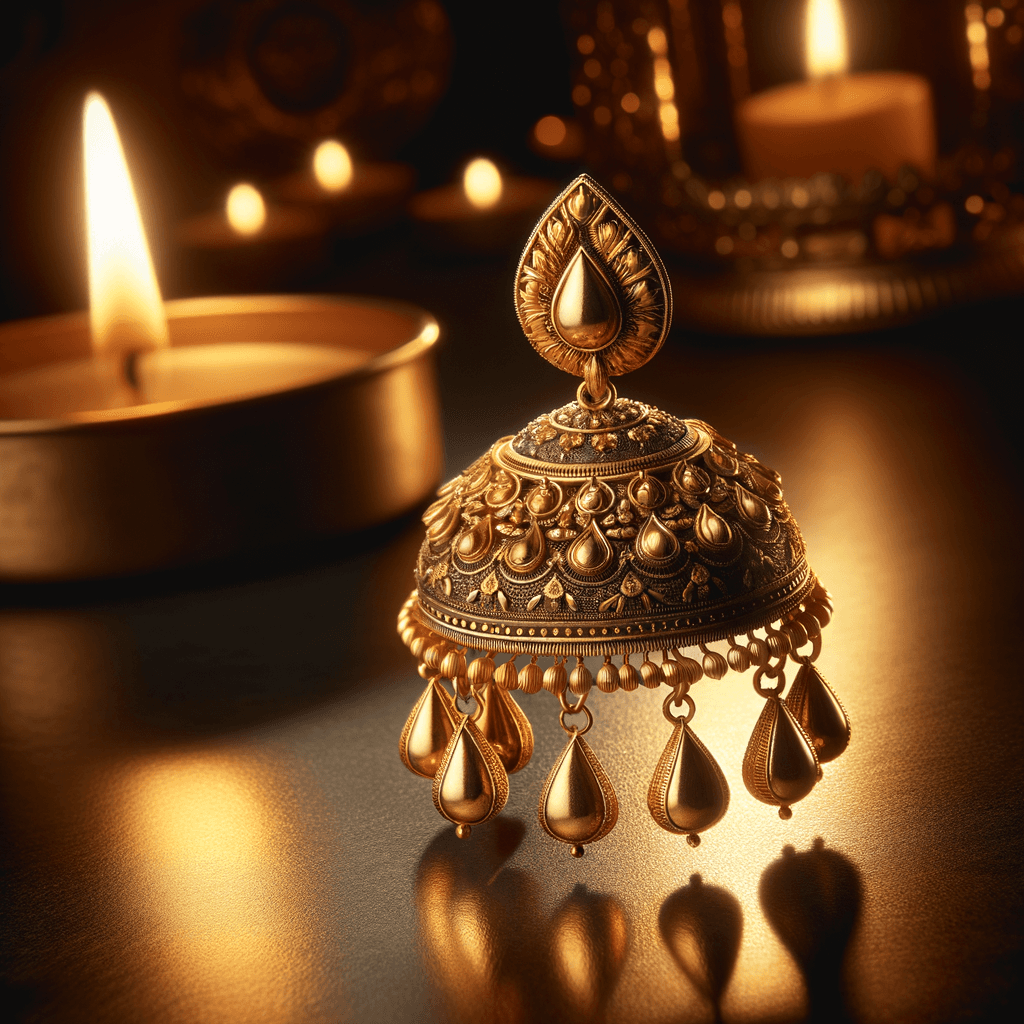
India is not one country. It is a hundred countries wearing the same name. The jumka, worn from Kashmir to Kanyakumari, tells a different story in every place it is made. The shape is recognisable everywhere — the hook, the dome, the drops. But the material, the technique, the weight, the sound — these change with the land.
In Jaipur, the jumka wears the desert's palette. Meenakari — a centuries-old enamel technique brought by Persian craftsmen to the Mughal courts — fills the gold with colour. Cobalt, saffron, green, ivory. The craftsman fires the enamel at temperatures that would melt most metals, then polishes it until it catches the light like a jewel.
The Rajasthani jumka is theatrical. It does not sit quietly. It announces. It was made for the women of Rajput courts, for the festivals of colour, for the desert evenings when the temperature drops and the stars appear and everything becomes vivid.
Hyderabad was the city where the Mughals lingered longest after Delhi fell. The Nizams kept their courts in full flower well into the twentieth century, and the jewellery of their craftsmen carries that lineage.
Kundan — gold foil set around uncut gemstones — is the Hyderabadi signature. The setting creates a luminous, slightly hazy quality, as if the stone is floating in the gold rather than pressed into it. The Hyderabadi jumka is layered: multiple tiers of drops, each catching light independently, so the earring moves like a small waterfall.
In Kolkata's workshops, craftsmen practise taar-kaj — the art of drawing metal wire to near-impossibility, then weaving it into patterns of extraordinary delicacy. A single jumka might contain hundreds of metres of silver wire, twisted and soldered by hand.
The Bengali jumka is the lightest of the four traditions. It achieves intricacy without weight, like a sentence that says everything without a wasted word. It is the earring of the scholar, the artist, the woman who moves through her day without wanting to be slowed down.
Kashmir's jumka is shaped by two things: altitude and isolation. For centuries, the valley was accessible only by difficult mountain passes, and its craftsmen developed their own visual language, drawn from Persian miniatures, walnut wood carving, and the patterns of the chinars that turn gold in October.
The Kashmiri jumka works in silver, often oxidised to a dark patina that catches light only on the raised surfaces. The effect is of something ancient — a piece that looks as if it has been in a family for generations, even when it is new.
Four traditions, four cities, one earring. The jumka is the thread that connects them — and wearing it is a way of carrying that entire geography on your ears.